In praise of the cheap handheld
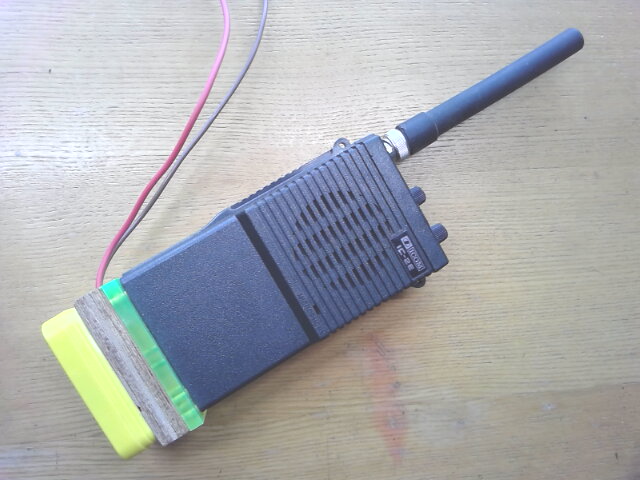
From the distant past when the world was young comes the Icom IC-2E. It is a rugged, simple, no-nonsense 1.5W 2m FM handheld greatly appreciated by RAYNET types and lovers of the plain but wholesome generally. Its huge PTT can easily be operated with a gloved hand, its issue rubber duck antenna actually works, and it is big enough and ugly enough to look after itself.
The IC-2E has no keypad or display, thus avoiding two of the most troublesome components in a portable rig. It uses mechanical thumbwheels and a ‘+5kHz’ switch to set the working frequency. In the RigPix photo the wheels read 5 7 6 and the switch is on, giving a working frequency of (1 4, assumed) 5 . 7 6 + 5kHz = 145.765MHz.
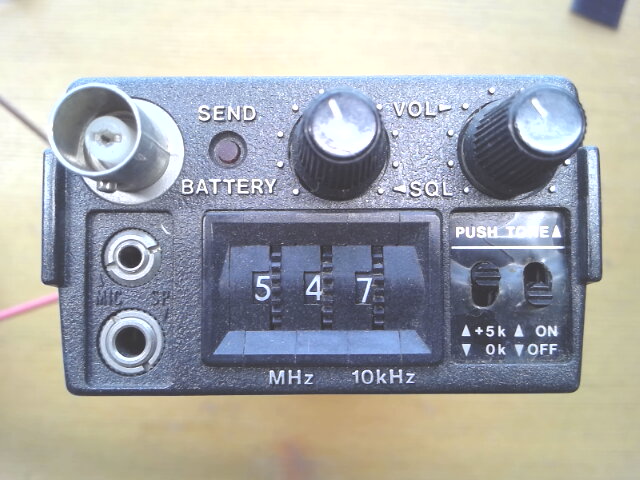
This arrangement has the great advantage of resisting ‘accidental’ change by giving bored RAYNET operators hardly anything to play with. The rig’s output power, low by today’s standards, was and still is appropriate to most handheld-based operations which involve radio ranges in hundreds of metres.
The battery of the IC-2E was a nickel-cadmium (Ni-Cd, pronounced ‘nicad’) type. This type of battery is now hardly used as they have only modest capacity and are tricky to keep properly charged. Also they tend to wear out, or to be knackered by improper charging, which is why working IC-2Es nowadays, like this museum piece, usually have specially made power adaptors.
Though the IC-2E is a very fine handheld it was never cheap. In 1981 at the height of its vogue it cost £159, a vast sum at the time and of the same order as the price of a new Yaesu FT-290 (£220 in 1981) or even that of a just-roadworthy car. This meant that it was never widely adopted, remaining largely as a RAYNET status symbol. The author, a penniless scholar, never had one of his own in the 1980s for exactly this reason, and habitually did RAYNET /P ops with an elderly secondhand FT-290 in its issue shoulderbag, which as all-the-rig-there-was had to do for everything.
Fast forward (now there’s another term we hear only in the museum) forty-five years. Retail price inflation has occurred. The IC-2E, were it still available, would according to the Bank of England now cost £636.39 (and the FT-290 over £800).
For this sum at today’s e-bay price of £17.67 one could currently purchase thirty-six Baofeng UV-5R handhelds.
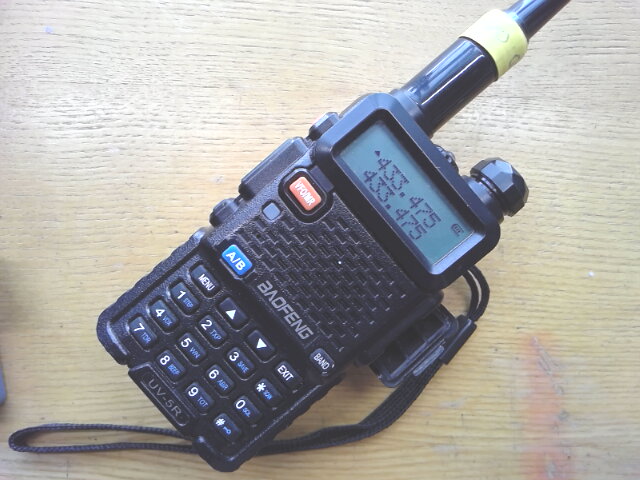
The UV-5R though nowhere near as lovingly made as the IC-2E gives 1W or 4W (some of its many variants do more) of FM on 2m or 70cm. It is supplied with a small battery, a charger and a standard antenna and is ready to work once charged up. Larger batteries and all kinds of accessories are available for it.
It could be argued that the UV-5R is too cheap. Strict regulators do not like it as its harmonic control is slovenly and it can easily be ‘widebanded’, or made to transmit out of band. Its own-branded accessories are OK but third party ones are often terrible. Its issue antenna barely works and is always replaced in service with a much larger and better designed type, usually the Japanese Nagoya NA-771, a genuine specimen of which costing a little more than the rig, or a copy of it, some of which are just as good.
The Yaesu FT-65, on the other hand, is not so cheap, commonly selling for just under £100 though Lynchy has a special on them today for £85.
This rig is rather plainer and more wholesome than the UV-5R, lacking accessories and thus likely to remain just a handheld, though its issue antenna is similarly almost useless and is in this instance replaced by a Diamond branded copy of the Nagoya 771.
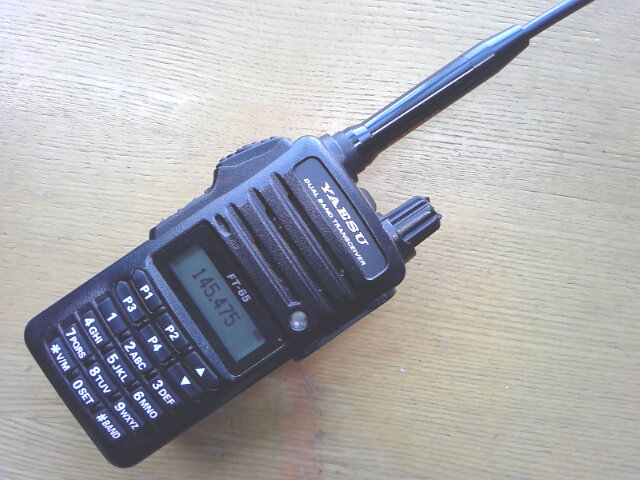
What really, really matters about both of these rigs is that they are switched on, now.
The Baofeng is monitoring 433.475 and the Yaesu 145.475. Though neither has spectacular long-range radio performance, at the same time neither is likely to miss anyone in this town transmitting on a Club frequency.
Indeed, the Yaesu sitting on the desk has just worked on 2m a Club member driving through who would not have been heard at all by the main rig as it was switched off at the time, being out of earshot downstairs.
As they are so cheap, another UV-5R could be assigned to monitor any other frequency in the 2m or 70cm bands should this be required. The setup, unlike an SDR or scanner, provides a portable transmitter for each band and a degree of redundancy.
The UV-5R and its friends-and-relations are so cheap that all radio amateurs able to pay their own exam fees ought to have one, if only to be able to say “Ah yes; I too have one of those.” Those unable to pay their own exam fees are advised to apply to the Club whose Magic Hat, though invisible, has often given satisfaction in the past.
Carried routinely on the person, the handheld acts as a super de luxe novelty amateur radio badge, as good as one of those electric T-shirts; people say “What on earth is that?” and are dragged inexorably into a conversation about amateur radio, which might even result in their joining the Club and having a handheld of their own.
At the same time the UV-5R is so cheap that the budget would probably survive its accidental loss and so it can always be taken into the gorge of ultimate peril, though it is definitely not waterproof and when operating e.g. in the rain, or from an inflatable chair in one’s swimming pool, ought to be put in a waterproof radio bag (about £5).
The most important thing is that whatever one has, a cheap as chips (and cheaper than a Chinese) Baofeng, a sensible Yaesu, or Icom’s latest not-really-cheap-at-all substitute for the IC-2E, one has it running all the time, snatched from its charger as one goes out to maintain radio watch on one’s chosen frequency and always ready to respond, and dutifully returned to the charger when one comes back.
Doing this, calling ‘Monitoring’ regularly and particularly when one moves, and responding to any calls heard, will without any more cost or effort maintain a radio net of everyone within handheld range and tuned to that frequency, all of whom will be at least sometimes listening and able to respond to a call, possibly by turning up in person in the event of some emergency.
It costs certain government organisations a fortune (though of course it’s only taxpayers’ money) in equipment and training to try to maintain this sort of instant response radio capability among their staff but with a twenty quid handheld and a well-practiced habit we the radio amateurs can perhaps do much the same thing.
Free radio
The free radio story is no different from that of licensed amateur radio except that handhelds for CB are quite uncommon and the few that exist are not very handheld at all, having huge antennas and often heavy battery packs.
Most CBers already have one or more mobile type CB rigs going, as there are two CB bands, when they are at home or driving, and the majority call regularly on the appropriate channels. This whole rant is about trying to get the radio amateurs to do the same. However CBers don’t often have 27MHz handhelds at all.
On the other hand there is PMR446, which is more or less the same as 70cm FM amateur radio, only with a half-watt power limit. This is comparable with the fixed 1.5W of the IC-2E and the 1W/0.5W/250mW/100mW ‘low’ settings of the UV-5R, the FT-65 and other portable rigs, giving ranges similar to those available e.g. to security staff in shopping malls, whose firms sometimes use low-cost, zero-paperwork PMR446 themselves, professional-grade rigs now being available.
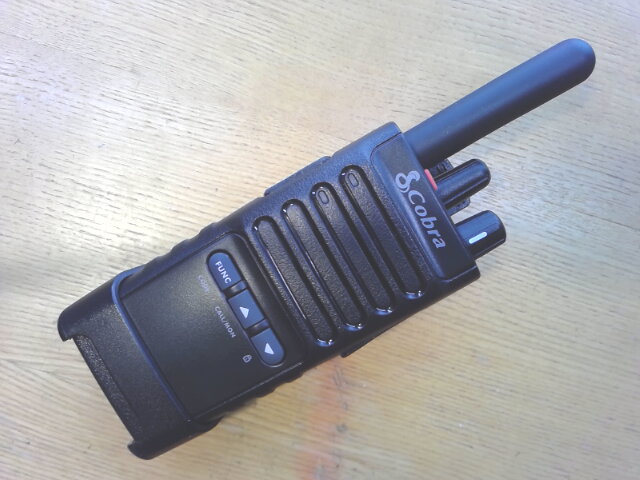
Some of these business class PMR446 rigs are noticeably better made than the UV-5R, but the one illustrated is more than twice the UV-5R’s price. Note the absence of a keypad or display, shades of the IC-2E; this rig, like the UV-5R, talks to its user.
At the moment the Club has settled on PMR446 Channel 07 without CTCSS or DCS as its ‘Club channel’, though this might change, please watch the website. The rig in the picture above, having been delivered during the writing of this article, is now monitoring Channel 07.
Owing to the shorter range of PMR446 it is as well to call ‘Monitoring’ on this service rather more often than one would on a longer range service like CB or 2m, in order to catch fleeting signals.
It seems that the new LPD433 FM voice service, also in the 70cm band like PMR446, now has its standard 100mW handhelds, only one fifth as powerful as PMR446, being used by SOTA enthusiasts to activate summits, suggesting that it is time the free radio section got its hands on some to check them out.