Receiving images from the International Space Station
We received these pictures in Glastonbury directly from the International Space Station using slow scan TV (SSTV).
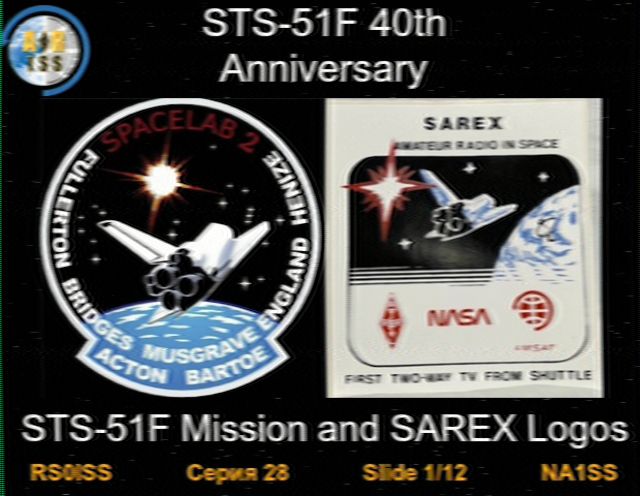
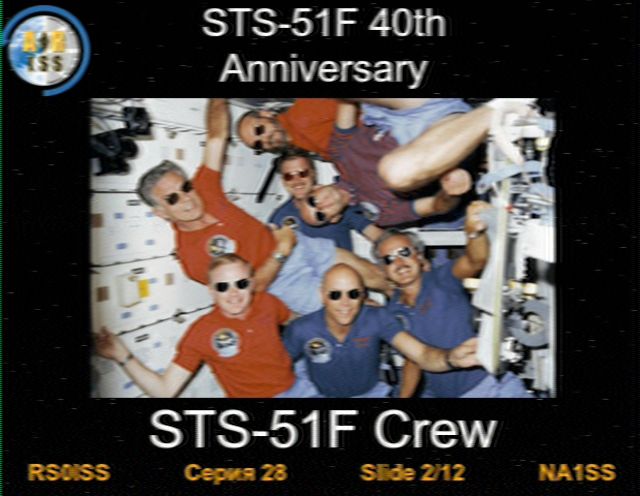
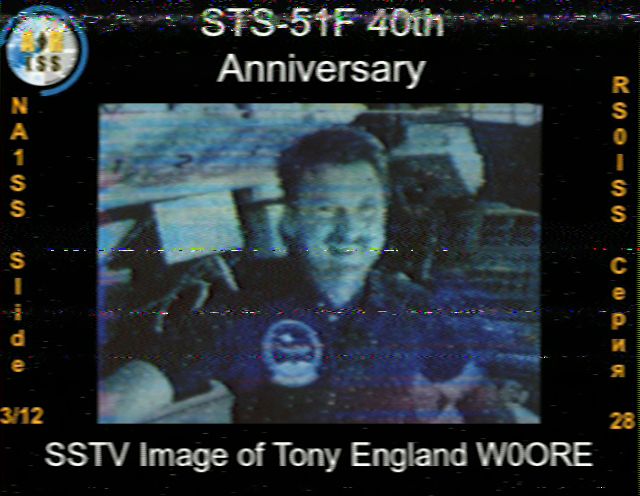
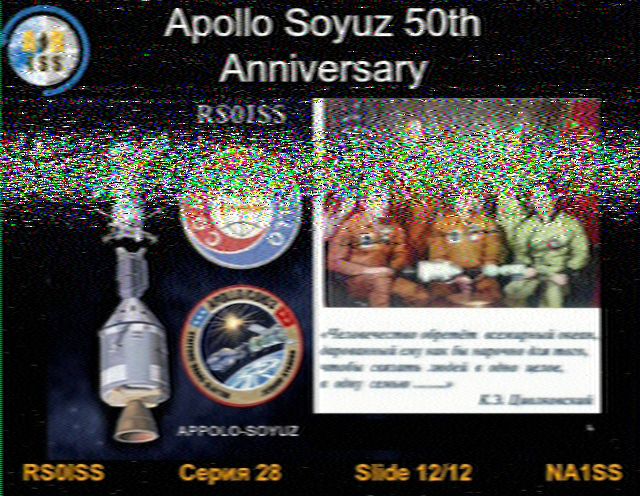
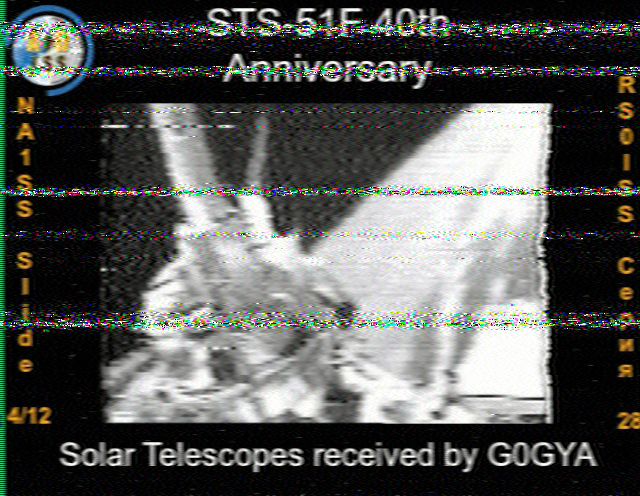
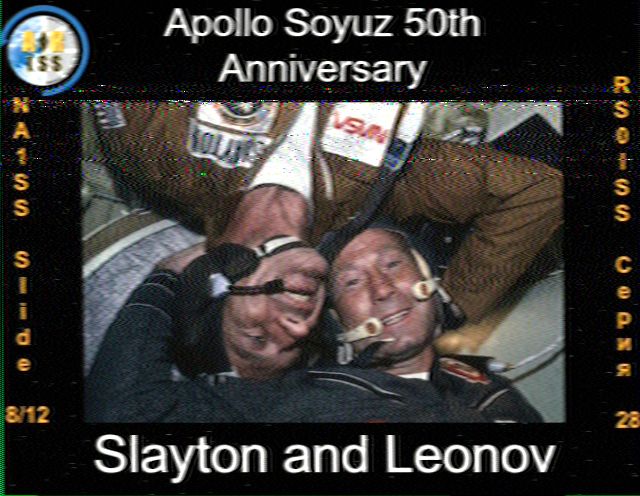
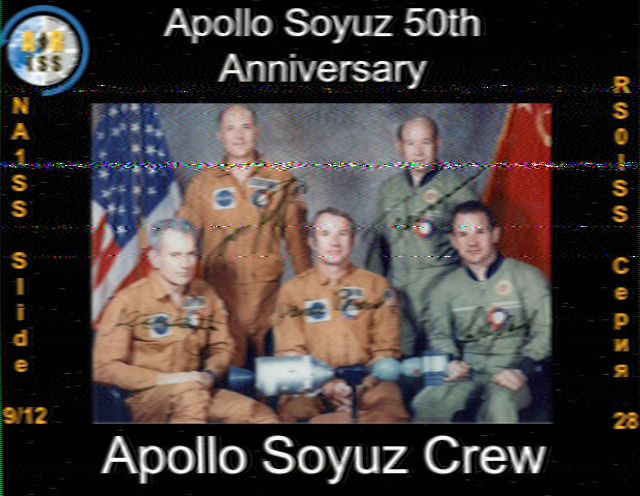
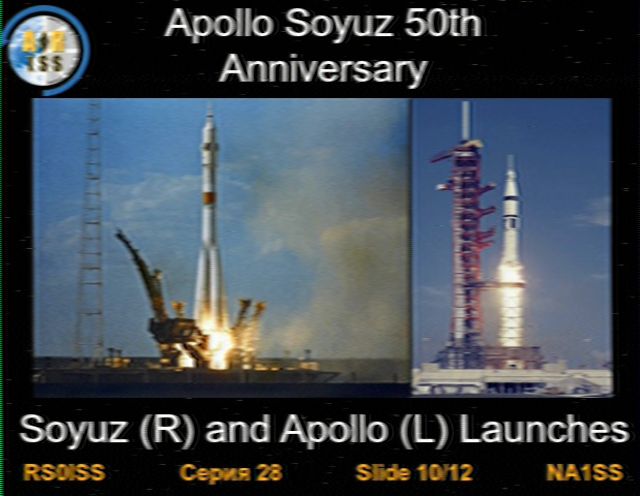
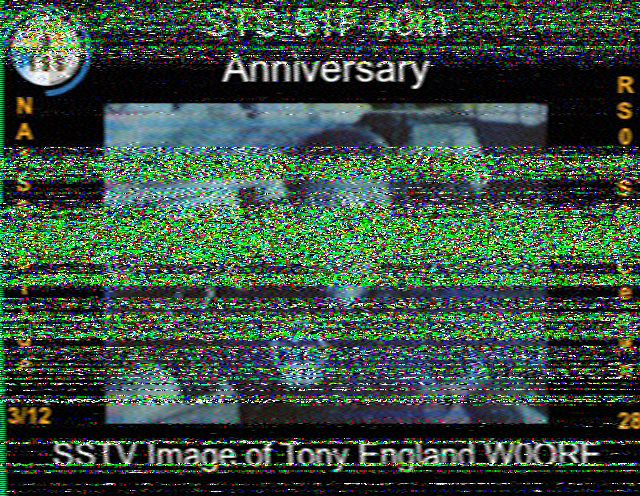
AMSAT has details of the activity period in mid-July Our first reasonably successful image passed over Glastonbury on the 15th July at 18:22 UTC
There’s something curiously meta about the first image being a SSTV image of an SSTV image from 40 years ago. The images are of the STS-51F Shuttle launch on the 29th July 1985. One engine out of three failed and the mission was aborted to orbit - taking up a lower orbit that planned because it was already past the point of no return when the engine failure occurred.
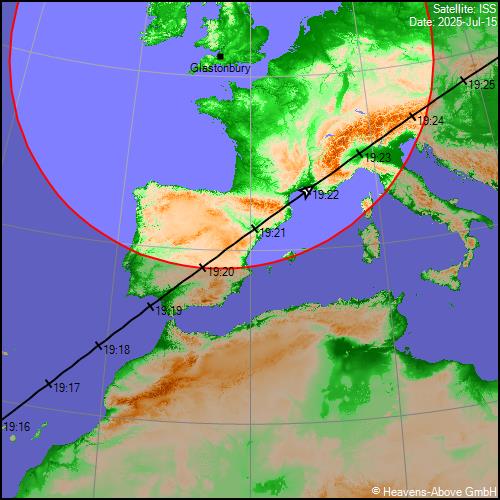
Because this is low and at a distance I used a X510 collinear into an RSP1.
equipment used and setup
Equipment was set up similar to last time in 2021. This time I had more success with overhead passes and the horizontal dipole. The RSP-1 has an AFC command in the extended menu, and I used this to track the Doppler shift of the signal as it passes overhead, it can be +3kHz to -1kHz (my elevation horizon is limited to the east). The AFC only works when the signal is strong enough to be heard clearly, I toggle it off in fades and back on again. It is easier to optimise the signal without de-emphasis as the crackle is louder as the signal weakens. I record the signal without de-emphasis to feed into MMSSTV - SSTV is a FM baseband signal carried on a FM carrier so image brightness and colour difference is carried in the zero-crossings.
I use Heavens Above for predictions. This can only give you a prediction if you log in and set your location, note that the times given are in local time (BST at the moment) not UTC. Remember to tick the ‘all passes’ box - you aren’t trying to see the ISS visually.
A transmission is usually in progress by the time you acquire the signal, this will be a partial image so I tried rotating the antenna to see if there is any value in trying to angle it perpendicular to the line of flight. There doesn’t seem much in it, the default orientation of the dipole N-S is good enough.
ARISS Diploma
You get a nice ticket for a successful receive if you upload it to ARISS usa
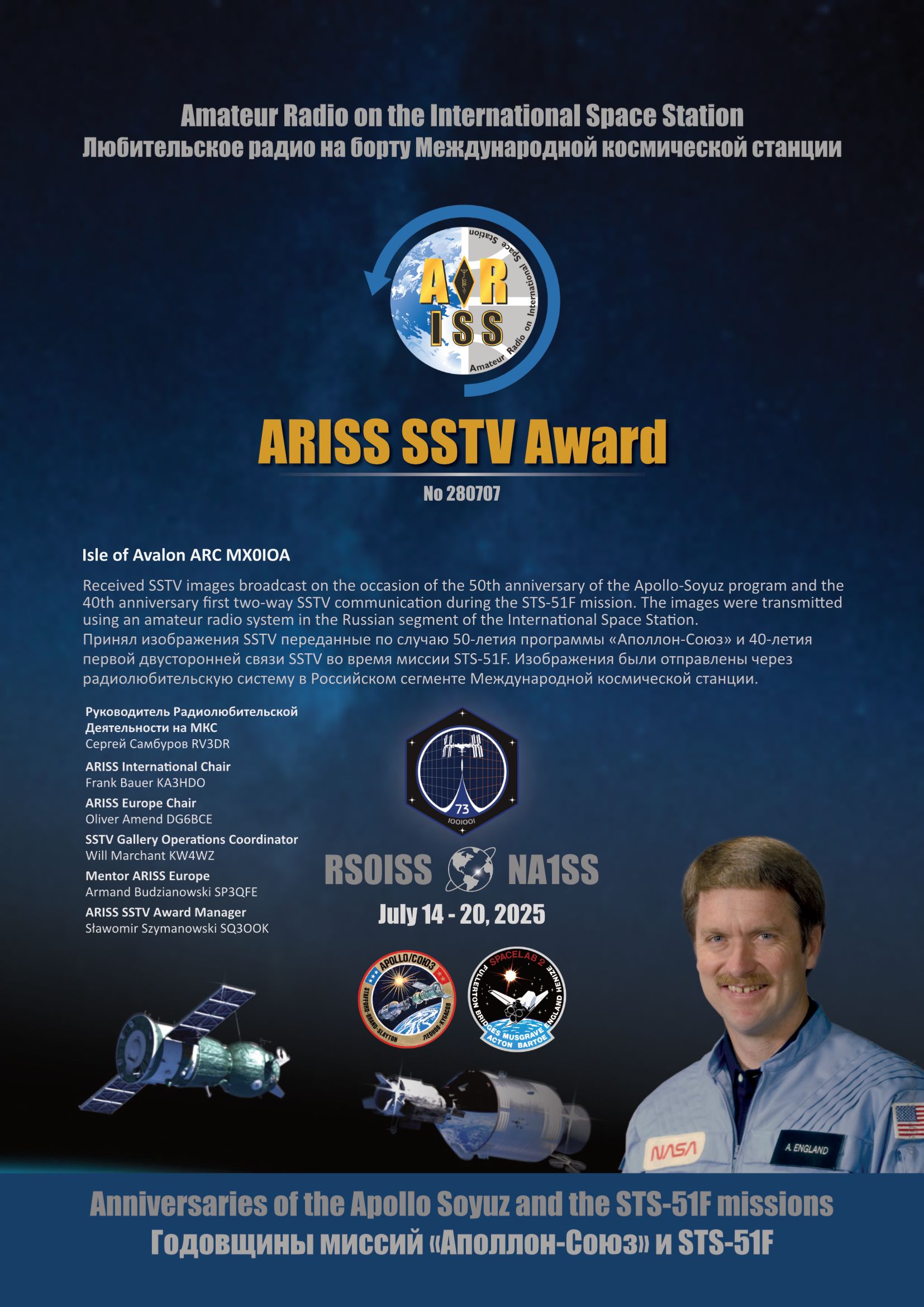
and a little bit more about the mission and these pictures
The images of the SSTV series 28 refer to two important events.
This year marks the 50th anniversary of the Soyuz-Apollo space mission, also known as the ASTP (Apollo-Soyuz Test Project), which was a joint space project of the USSR (Russia) and the United States. Its purpose was to dock the Soyuz and Apollo spacecraft in orbit. This mission, carried out in July 1975, was the beginning of cooperation between the two countries in space exploration. On July 15, 1975, the Saturn IB rocket with the Apollo command module and docking module launched from Cape Canaveral. On the same day, a Soyuz rocket took off from the Baikonur Cosmodrome, carrying the Soyuz 19 spacecraft. The docking of the Apollo and Soyuz spacecraft took place on July 17, 1975. The crews spent several days in orbit together.
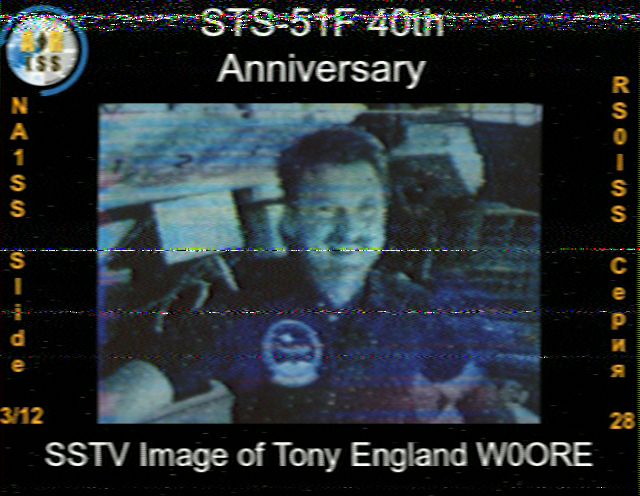
40 years ago, Tony England W0ORE during the Challenger shuttle mission STS 51-F in 1985, he achieved the first ever two-way Slow Scan TV (SSTV) space contact.
Tony was running a Motorola model MX-340 handheld 2-meter transceiver and a Robot Research model 1200C slow-scan television scan converter with an antenna fitted on the inside of one of Challengers windows.
STS-51-F (also known as Spacelab 2) was the nineteenth flight of NASA’s Space Shuttle program, and the eighth flight of Space Shuttle Challenger. It launched from Kennedy Space Center, Florida, on 29 July 1985, and landed at Edwards Air Force Base, California, just under eight days later on 6 August 1985, at 12:45:26 pm PDT.The diploma shows the Apollo and Soyuz spacecraft approaching each other in orbit, as well as a photograph of Tony England.
Collinear vs horizontal dipole
A typical collinear 2m antenna favours the horizon and often has a dead spot vertically overhead. It may have lobes in the vertical plane, as the ISS passes it may go through these. On the other hand a low pass of the ISS where the highest point of the arc is 20 degrees is quite well suited to the vertical collinear.
The horizontal dipole oriented NS has fewer lobes in the elevation. It’s good for high-angle overhead passes, and the signal is stronger because the ISS is closer. I tried a simultaneous comparison with a highest point of the arc at 60°.
Heavens above listed this pass (times converted to UTC) so a maximum of 60 degrees
19th July AOS 18:18:04Z 10° WSW max azimuth 18:21:23Z 60° LOS SSE 18:24:42Z
I rigged a FT3DE with the main station antenna, a X510 vertical collinear. and at the same time the horizontal dipole. I used the RSP-1 for the horizontal dipole and the FT3DE’s record audio feature for the collinear.
for my QTH passes over 50° are probably better on the horizontal dipole. The FT3DE signal will be de-emphasised, but that should reduce the noise on weak signals.
Try it yourself with a handheld
You can hear the signal on 145.800 MHz with a handheld like a Baofeng, and there are mobile phone apps to decode SSTV - search SSTV on your app store. You can decode using the microphone of the phone to pick up the sound from the handheld speaker is the environment isn’t too noisy. The information is carried in the frequency not amplitude so the primitive coupling method is OK. You’ll give yourself a better chance if you select a high angle pass, favour passes with a higher alt. value where the signal should be stronger and the pass longer.
If you want to try this out then play this audio file (8kHz sampling, mono, A-law) into your SSTV app
It should give you this image. Apps should autodetect, the SSTV format is PD1201
-
The SSTV PD120 mode was developed way back in 1997 - read more about it here ↩